A sibling nickname is the only one nobody agreed to. A partner picks theirs, a friend earns theirs — a sibling gets handed one at four years old by someone who was six, and then carries it to thirty. That is why «cute or funny» is the wrong way to sort these. The question that actually matters is who gave it, and whether it still works once you are both adults. Below are 96 names sorted that way, each with a line on what it signals. Tap any of them to run it through the generator, or use the copy button to take it plain.
96 nicknames for a sister or brother
Read the first two groups next to each other and a pattern appears that nobody plans and everybody follows.
What an older sibling calls a younger one
- The classic older-sibling name. Affectionate and very slightly patronising, which is the whole genre.
- Works until they overtake you, at which point it becomes much funnier.
- Only survives in families where nobody is precious about it. Read the room first.
- Ages better than Runt because it stops being literal and starts being ironic.
- The one that lasts longest — plenty of forty-year-olds are still Kiddo to a brother.
- Suggests growth rather than smallness, which is why it does not curdle.
- The softest of the shrinking names, and the most used by a wide margin.
- Old-fashioned enough now to read as deliberate.
- Puts them one rank below you without saying anything about their size.
- Works even when it is not literally true. It is about order, not names.
- Names a real thing they did for ten years. Fond, not cruel.
- Two syllables of nothing, used by more older siblings than any word with an actual meaning.
- Reverses the joke — you promote them to second in command, which they never were.
- The shortest version of the whole category.
- Names their reputation rather than their size. Usually well earned.
- Says you were the main character. They will dispute this for life.
What a younger sibling calls an older one
- The younger-sibling classic: inflate them, because they already outranked you.
- Same move as Boss, less formal, and it works whatever their actual size.
- Gives them a rank you invented. Younger siblings do this instinctively.
- Half-mocking and half-true, which is the correct ratio for an older sibling.
- Short, admiring, and easy to say in front of anyone.
- Names the fact you cannot change — they were here first.
- The engineer’s version of The Original. Funnier and slightly ruder.
- For the one who taught you something real, and will not let you forget it.
- Plain and warm. The one that appears in more messages than any invented name.
- Same, on the other side.
- Literal birth order with a joke inside it. They will pretend not to like it.
- Deliberately formal, which is what makes it a joke.
- Modern, flattering, and rarely used yet.
- For the sibling who settled every argument, whether or not you asked.
- For the one who went through everything first so you did not have to.
- Names the relationship honestly. Works only if you both find it funny.
The ones that still work at thirty
- Never stops working. Say it at a funeral or a wedding and it fits both.
- Same, and the only one on this page a stranger might also use.
- Warm in a lot of families, though it lands differently outside them.
- Neutral enough to survive a partner, a boss and a parent hearing it.
- Used constantly by people who are not twins. Says exactly what it means.
- Says the relationship rather than the rank. Works at any age.
- When the sibling is genuinely also the friend. Rarer than people claim.
- Just the adjective, used as a name. Somehow more affectionate than Big Sis.
- Plural for a set of younger siblings. Practical and warm.
- Fond, a little rough, and it holds up for decades.
- One syllable. Lasts forever precisely because it stops being accurate.
- Short for sibling. Neutral, modern, and useful when gender is not the point.
- Old-fashioned and gentle, and it has aged into charm.
- For the sibling everyone in the family calls about their symptoms.
- Said by the one who is not. A joke everyone in the family understands.
- For the years you shared a room. It carries a whole decade in six letters.
Funny ones that name a real event
- Names a documented crime. Every family has one.
- Same energy, different object.
- Said by whoever is not. Accurate in almost every family.
- Short for «the reason we can’t have nice things». Everyone fills in the rest.
- The oldest joke between siblings, and it never stops working.
- For the childhood telling-on. Funny only once everyone is grown.
- For the sibling who woke the whole house every morning.
- For the one who commented on your driving before they could drive.
- Named after a door. They know exactly which one.
- For the sibling who could talk your parents into anything.
- For the one who corrected you, constantly, and was usually right.
- For the small chaotic years. Fond in retrospect, less so at the time.
- Named after where it was always left.
- As in «turn down the». One word, whole personality.
- For the sibling who came after and, everyone agrees, improved on the formula.
- For the one nobody was expecting — usually the youngest by several years.
Sister and brother from another mother
- The full form of the phrase, and still the most used.
- Its counterpart. Both are old and neither has worn out.
- Warmer and less jokey. For the friend who became family.
- Friend plus family. A made-up word that has stuck.
- Says the important part: this one was picked, not assigned.
- Over the top on purpose, which is why it lands.
- Says the same thing without the family words at all.
- Names the feeling instead of the relationship. Very current.
- Softer, and used more between friends than between actual siblings.
- Not romantic here. Works fine when the context is obvious.
- Used loosely in a lot of families for anyone close enough.
- Said as a joke by the person who is not. Everyone knows what it means.
- Names the length of the friendship rather than its nature.
- A joke term borrowed from television, used between close friends.
- The old English word that «gossip» came from — literally a sibling in God.
- Old, warm and slightly grand. Good for a group rather than one person.
In other languages
- Spanish, «little sister». Used with real warmth, not condescension.
- The brother version. Both are common well into adulthood.
- The shortened form, used across Latin America for a close friend too.
- French, «little sister». Formal on paper, tender when spoken.
- French slang for brother, roughly «bro». Very current.
- Italian for sister, used as a name the way «Sis» is in English.
- The brother version. Long, but Italians shorten it to Fra.
- Hindi and Bengali for older sister. Also used for any older woman you respect.
- Hindi and Urdu for brother — one of the most-used words on this whole page.
- The affectionate form of Bhai, for an older brother specifically.
- Hindi for «little one», used for a younger sister.
- Tagalog for older sister, used for any older woman you are close to.
- Tagalog for older brother, used the same way.
- Korean, what a younger woman calls an older sister or close female friend.
- Korean, what a younger woman calls an older brother or close male friend.
- Japanese for older sister. Affectionate, and instantly recognisable to anyone who watches anime.
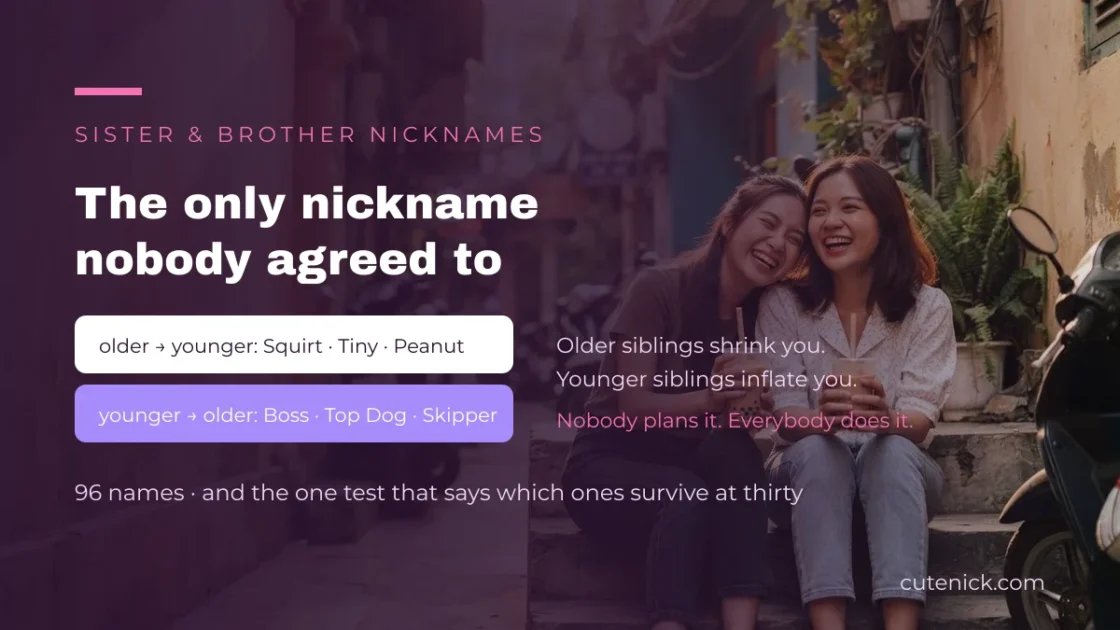
Older siblings shrink you. Younger siblings inflate you.
It is in the lists above and it is remarkably consistent. Names that travel down the birth order make the person smaller — Squirt, Shorty, Tiny, Peanut, Nugget, Small Fry. Names that travel up make them bigger — Boss, Top Dog, Skipper, Folk Hero, The Original.
Neither direction is unkind, and both are doing the same job from opposite ends: marking a gap that was enormous when you were seven and stopped mattering some time around twenty-five. The older sibling keeps the younger one small because that is when the relationship was formed. The younger one keeps the older one large for exactly the same reason.
Which is why so many sibling nicknames outlive their accuracy and get funnier for it. «Shorty» said to someone six inches taller than you is not a description any more — it is a date stamp.
The test: can you say it in front of their partner?
Sibling nicknames are the ones most likely to have aged badly, because they were chosen by a child. There is one filter that sorts them fast, and it is not whether you still find it funny.
- Say it in front of the person they are dating. If they wince, it is a childhood name and it belongs at home.
- Say it in front of your parents. Different test, different failure: some names are fine between you two and land badly with an audience that remembers the incident.
- Say it in a group where nobody knows the story. A name that needs three minutes of context is not a nickname, it is an anecdote with a handle.
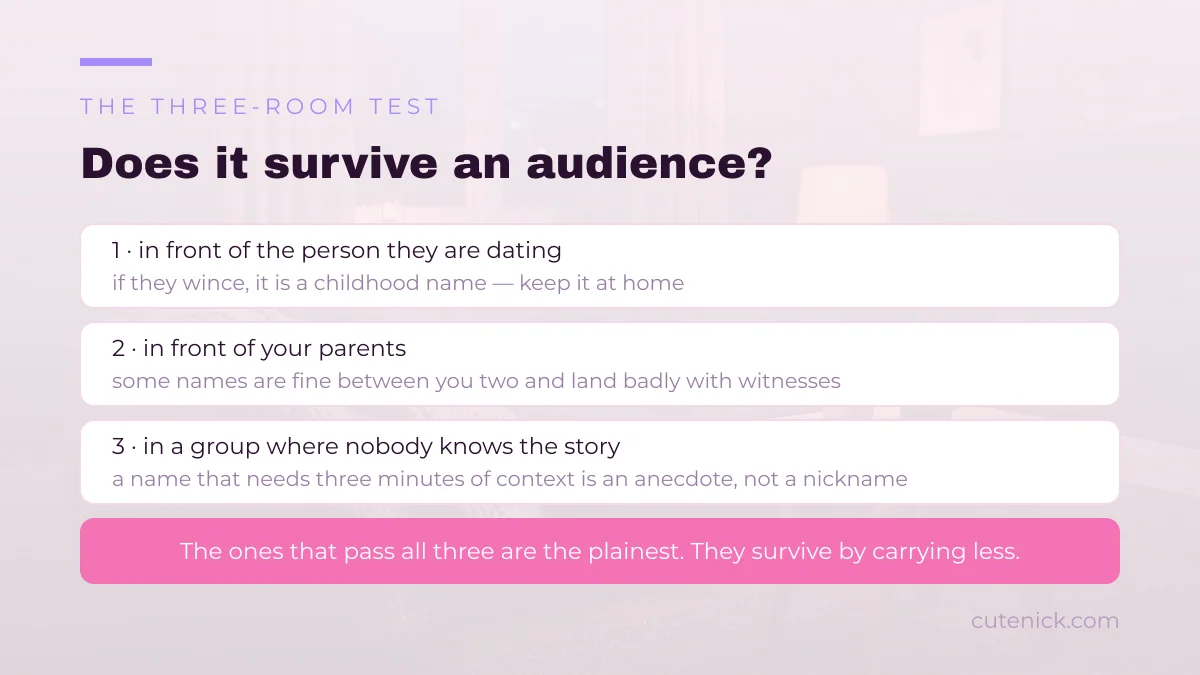
The ones that pass all three are almost always the plainest — Sis, Bro, Kid, Big — and that is not a coincidence. A nickname survives adulthood by carrying less, not more. The specific ones stay wonderful in private and stop travelling.
And the category to be most careful with is the one built on how someone looked as a child. Bodies change; the name does not. A nickname built on something they did — Fridge Raider, The Negotiator, Referee — is still true in twenty years and never becomes a sore point.
«Sister from another mother»
One of the most searched versions of this question is not about a sibling at all — it is about the friend who became one. The phrase is old and has not worn out, and the reason is in the words: it names the thing that makes chosen family different, which is that it was chosen.
Two practical notes if you are picking one of these. First, the long forms — «Sister from Another Mister», «Brother from Another Mother» — are jokes and know it; they work in a caption, not in daily speech. Second, the short ones do the same job without the wink: Day One names how long, Framily names what it is, and Chosen One names the only part that matters.
Sister and brother in other languages
Several of these are used in English-speaking families every day, and two of them are among the most-used words on this entire page.
| Word | Language | What it means, and who says it |
|---|---|---|
| Didi | Hindi, Bengali | Older sister — and any older woman you respect, related or not |
| Bhai · Bhaiya | Hindi, Urdu | Brother · older brother, affectionately. Bhai is also used for close friends |
| Ate · Kuya | Tagalog | Older sister · older brother. Used for anyone older you are close to |
| Unnie · Oppa | Korean | What a younger woman calls an older sister · an older brother |
| Hermanita · Hermanito | Spanish | Little sister · little brother, said with warmth rather than condescension |
| Frérot | French slang | Roughly «bro». Current, and used far beyond actual brothers |
| Onee-chan | Japanese | Older sister. The -chan ending is what makes it affectionate |
Worth knowing about the first four rows: these are titles as much as nicknames. In Hindi, Tagalog and Korean, calling someone Didi, Ate or Unnie is partly a mark of respect for being older — which is the opposite of how English sibling nicknames work, where the older one gets the affectionate diminutive and the younger one gets promoted as a joke.
Saving them in your phone
Ready-made contact names
Name plus one emoji. Sibling contacts get looked at more than almost any other — this is the one that shows when they ring at eleven at night.
Emojis that suit a sibling
The hearts and the hands work for anyone. The second half is where it gets specific — an object that names a shared thing beats a heart every time.
Plain characters, if an emoji is too much
Text symbols rather than emoji, so they stay the same colour as the name and do not stretch the row in a contact list.
Text faces
Ordinary characters, so they look the same on their phone as on yours.
Styling it for a contact or a bio
Run any of these through the generator and you get 𝓑𝓲𝓰 𝓢𝓲𝓼, 𝗕𝗶𝗴 𝗦𝗶𝘀, ʙɪɢ sɪs. Those are separate Unicode characters that look like styled letters, which means:
- A contact name keeps them — contacts are stored as typed, and they sync looking the same.
- A bio keeps them — also plain text.
- Contact search does not. Searching for «Sis» will not find 𝓢𝓲𝓼. If you style a sibling’s contact you will be scrolling to find them.
- Small caps is the survivor — ʙɪɢ sɪs is built from ordinary letters rather than the mathematical block, so it comes through in more places.
Hindi words for a sister or brother, in native script
These are real Hindi words people use for friends and family. The native script is copy-ready; the transliteration and meaning are in each line.
Hindi sibling words
- Didi: elder sister. Used with respect and warmth; also for an older cousin.
- Bhaiya: elder brother, with the same mix of respect and love.
- Chhotu: little one. Affectionate for the youngest boy in the family.
- Gudiya: doll. A pet name for a little sister or a young daughter.
- Behna: sister, often used by a brother for his sister.
- Bhai: brother, used by siblings and friends alike.
- Bade bhaiya: big brother, the eldest of the brothers.
- Chhutki: the smallest girl of the house. Teasing but loving.
Frequently asked questions
What is the best nickname for a sister?
The plain ones last longest: Sis, Big, Kid. If you want something specific, build it on something she does rather than how she looked as a child — those stay true and never become a sore point.
What can I call my older brother?
Younger siblings almost always inflate rather than shrink: Boss, Top Dog, Skipper, The Original, Folk Hero. It reads as affectionate teasing precisely because you are handing him a rank he never asked for.
What are some funny sister nicknames?
The ones that name a real event beat the ones that are simply silly: Fridge Raider, Remote Thief, The Negotiator, Slammer. Everyone in the family knows the incident, and nobody outside needs to.
What does «sister from another mister» mean?
A friend who is as close as a sibling. It is the counterpart of «brother from another mother», and both stay popular because they name the thing that makes chosen family different — somebody picked it.
What do Didi, Ate and Unnie mean?
All three mean «older sister» — in Hindi and Bengali, Tagalog and Korean respectively. In all three languages they are used for any older woman you are close to, not only a relative, and they carry a note of respect that English sibling nicknames do not.
Where do I find names for other people?
There are separate lists for a best friend, a boyfriend, a girlfriend and a husband, each with the meaning next to the name. For accounts rather than people, see cute usernames, and the generator on the CuteNick home page styles any of them.
Try these styles on your own name
The generator applies every style family at once.
Open the generator
CuteNick editorial team publishes cutenick.com, a free cute nickname generator and library. Character behaviour is tested against the Unicode Standard and dated inline.