«Coquette» is a real French word, and it does not mean cute. It means a woman who flirts in order to be admired — and it comes from coq, a rooster, because of the strutting. That is a much sharper word than the aesthetic usually admits, and knowing it changes which names actually fit: the ones that work are the ones with a little edge under the ribbon. Below are 90 coquette nicknames with what each one signals, the symbols and frames people really use on Instagram, and the ones that break on other people’s phones.
What «coquette» actually means
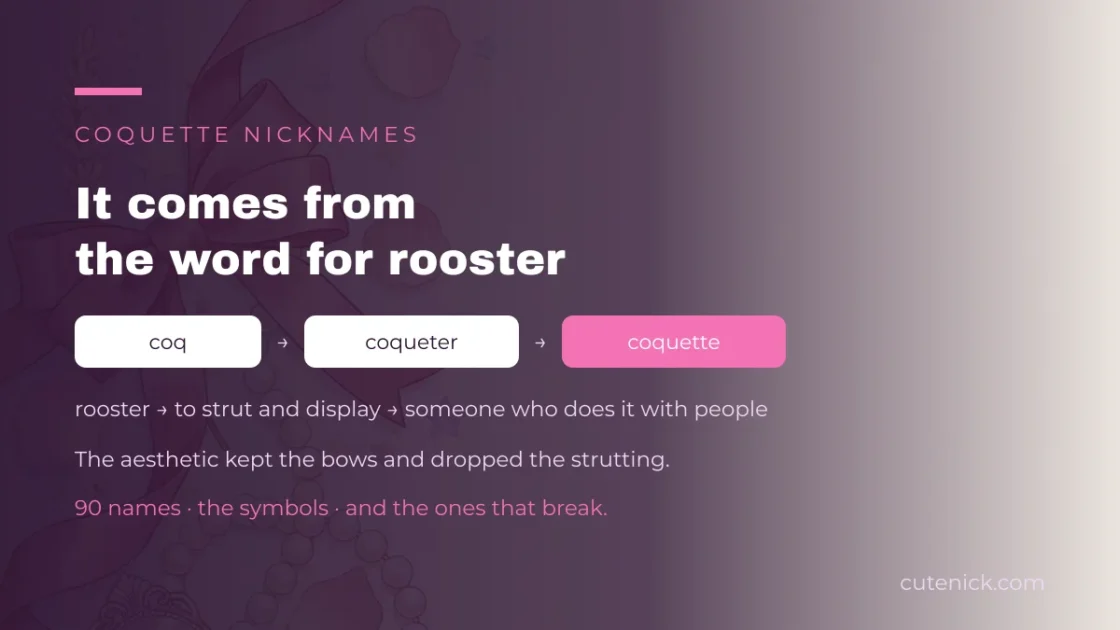
The word arrived in English from French in the seventeenth century and has been mildly disreputable ever since. The chain is short and worth knowing:
| Word | Meaning |
|---|---|
| coq | French for rooster |
| coqueter | to strut and display, the way a rooster does |
| coquet → coquette | someone who does that with people — flirtatious, attention-seeking, charming about it |
So the original word is not soft. It describes someone performing charm on purpose and enjoying it. The aesthetic that borrowed the name around 2022 kept the bows and the lace and quietly dropped the strutting — which is why the names that land best are the ones that keep a bit of it back: amourette, toujoursrose, bowsandbows. A name that is only sweet has removed the part the word was about.
And the bow 🎀 became the shorthand because it is the one object that is simultaneously decorative, deliberate and slightly excessive — three words that describe the original meaning quite well.
90 coquette nicknames
Grouped by which half of the aesthetic they come from. Tap any name to run it through the generator, or use the copy button to take it plain.
Bows, lace and everything soft
- The bow is the whole aesthetic in one object. Putting it in the name is the shortest route in.
- Two soft nouns, and the second one keeps it from being only about clothes.
- The «and» construction reads handmade rather than generated.
- A past participle. Reads like a description of a person, not a thing.
- Alliteration, and blush is the exact colour the aesthetic means.
- Fabric plus writing. Unusual, and it suits someone who actually writes.
- A jewel plus a unit of time — the most reliable coquette pattern there is.
- Sweet plus the object. Very taken; expect to need a variant.
- Two textures. Long, but it paints the whole picture.
- The «girl» suffix is everywhere in this aesthetic, so the first half has to work hard.
- A superlative, which is unusual in a handle and stands out for it.
- Object plus a quality. Softer than ribbonheart and less used.
- Colour plus fabric, joined the coquette way.
- A named shade rather than «pink». Always reads more considered.
- Repetition as a joke about the aesthetic itself. Rarely taken.
In French, where the word came from
- French for «my beautiful». Reads coquette without saying anything English.
- «Darling». The single most-used French word in this whole aesthetic.
- The full form. Longer, softer, and less crowded than cherie alone.
- French for «doll». Prettier than the English word and less loaded.
- «Pink ribbon». Two French words nobody has combined yet.
- French for «lace». One word, and it sounds like what it means.
- «Little flower». The -ette ending is doing the coquette work.
- «Kiss», the light kind you give on the cheek. Warm, not romantic.
- «Pretty pretty». Doubling is the oldest trick in any language.
- A brief, light love affair — which is almost the definition of coquette.
- French for «poppy», and it shares a root with coquette itself.
- «Fine pearl», a real jewellery term. Sounds expensive on purpose.
- An evening party. One word, one whole mood.
- «Cute», feminine. What French actually says where English says coquette.
- «Always pink». A small joke about committing to the aesthetic.
Vintage and old-money
- Names two aesthetics at once, which is why it is having a moment.
- A jewel and a time. Reads like the title of something.
- Old printing, used as a name. Nobody else has it.
- Same construction, softer noun.
- Flowers kept in a book. The most coquette object there is after the bow.
- Reads lived-in rather than new, which is the whole vintage half.
- Piano keys. Elegant and specific.
- Old-fashioned enough to read as deliberate.
- A real room in an old house. Slightly funny, entirely on theme.
- The doubled n rescues a word everyone wants.
- Same trick on a very coquette object.
- A date used as a name. Rare, and it means something only to you.
- Plural, and it implies a habit rather than one afternoon.
- Three syllables that carry a whole story.
- The bow again, aged a hundred years.
Ballet, the other half of the aesthetic
- The single most coquette object after the bow.
- A real ballet term, used as a name. Almost nobody has taken it.
- Rosin is what dancers put on their shoes. Specific enough to be a signal.
- Where a dancer starts. Long, and it earns it.
- Absurd on purpose, and it works.
- The «core» suffix on the most coquette-adjacent aesthetic.
- What ties the shoes on. Reads pretty and is technically accurate.
- A ballet reference without naming the ballet.
- Object plus fabric, both from the same world.
- The unglamorous half, which is why it is interesting.
- The extra e saves a word everyone wants.
- Plural, and it sounds better than the singular.
- Where the actual work happens. Understated on purpose.
- The doubled s, and the least glamorous garment in ballet.
- Two things a dancer wears on her head. Alliteration does the rest.
Song-coded, without naming a song
- Song-coded without naming a song. Very current.
- Deliberately misspelled so it is not a title. That is what keeps it free.
- Two ordinary words that mean something specific to this audience.
- Same idea. Reads innocent to everyone else.
- The misspelling is the point — it keeps it available.
- Sounds like a lyric, is not one.
- A place plus a time. The most reusable structure in this group.
- Doubled n on a word every account wants.
- Text-speak in the middle, which dates it deliberately.
- Doubled s, and it belongs to two different songs at once.
- Same trick, heavier word.
- Names a whole genre in three words.
- Invented, and it sounds like it should be a title.
- The bow again, in song register.
- Instrument plus adjective, doubled to survive.
Short enough for any character limit
- Four letters, and it hides a bow inside a name.
- Reduplication, two syllables, endlessly reusable.
- The same, and the softest consonant available.
- Five letters. Warm and completely un-taken in most places.
- Four letters. Reads vintage without being an actual old name.
- Pearl minus the a. Short, and it survives most character limits.
- Ruby with an i. The i is doing the coquette work.
- Reduplication again, higher pitch than mimi.
- French for silk. Four letters, and almost nobody knows it.
- Four letters, and it says the whole vintage half.
- Five letters, French-sounding, and it dodges the spelling everyone else takes.
- Four letters. Irish, and unusual in this aesthetic.
- Five letters, one fabric, entire mood.
- Four letters. Old-fashioned in the right way.
- French for jewel. Five letters and it is not taken anywhere near as often as it should be.
Coquette symbols and frames
The names above are only half of it. The other half is what goes around them.
The symbols people actually use
These are the ones that turn up again and again in coquette handles. Single characters, so they paste cleanly — see the warning below about the ones that do not.
Frames, ready to use
Replace «name» with yours. One frame is plenty; two makes the name unreadable in a follower list.
Emoji that belong to this aesthetic
The bow is the one everybody knows. The rest are the objects the aesthetic actually collects.
Soft text faces
The symbols that break — and why
Scroll back through the frames and you will notice some are made of one character each, and some are made of little marks stacked on top of one another. That difference decides whether your handle survives the trip.
- Single characters — ୨ ୧ ✧ ❀ ⋆ ⌗ — are one code point each. They render almost everywhere and they count as one character against a limit.
- Stacked marks — the tiny dots and ticks that sit above and below, like ݁ and ࣪ and ᩚ — are combining characters. On a device without the right font they collapse into an empty box, and the reader has no way of knowing something was there.
- And they cost more than they look. A frame that appears to be four symbols can easily be twelve characters. In a 30-character Instagram name, that is most of your budget spent on decoration.
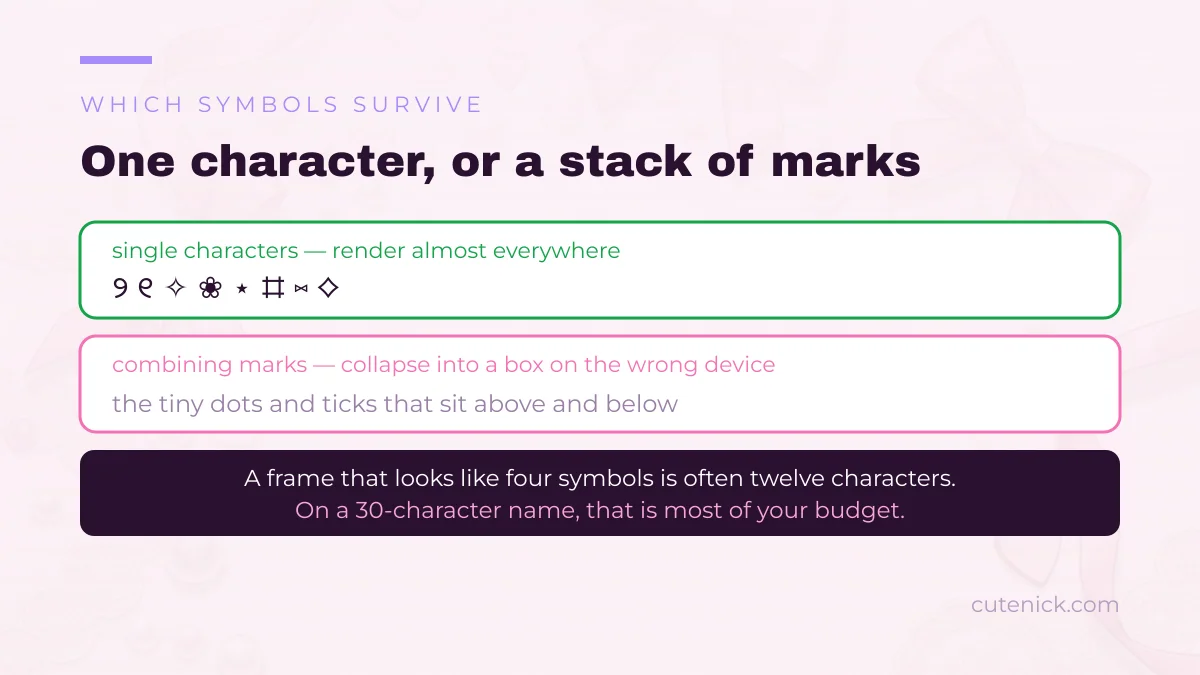
The practical rule, and it is the same one that governs every decorated name: build it out of single characters, and test it by sending it to one person on a different kind of phone. If it comes back intact, it is safe. The most beautiful frame in the world is worth nothing if half your followers see squares.
One more, specific to Instagram: the @username takes none of this. Handles allow letters, digits, dots and underscores — no symbols, no bows, no styled letters. The display name is the field that accepts decoration, and it is a different box on a different screen. That trips up more people than the fonts do.
Building one that is yours
A coquette handle is three decisions, in this order:
- The word. Pick from the list above, or take an ordinary word from the aesthetic — a fabric, a flower, a time of day, a ballet term — and put two of them together. Two words beat one, because one-word handles are all taken.
- One frame, not two. Either something on both sides — ୨୧ name ୨୧ — or one thing in front. Never both.
- Nothing else. The most common mistake in this aesthetic is a third layer: a frame, plus an emoji, plus styled letters. Pick one of the three. A name doing three things at once reads as noise, and the thing coquette is not is accidental.
And if you want the styled-letter version, run it through the generator at the top — but remember that 𝓬𝓸𝓺𝓾𝓮𝓽𝓽𝓮 and coquette are different characters, so nobody searching for you by name will find it. Style the display name, keep the handle plain.
Frequently asked questions
What does coquette mean?
In French, a woman who flirts to be admired — from coq, a rooster, because of the strutting. The internet aesthetic borrowed the word around 2022 for bows, lace, ballet and pale pink, and quietly dropped the sharper half of the meaning.
What does the 🎀 mean?
It is the shorthand for the whole aesthetic. The bow works as the symbol because it is decorative, deliberate and slightly excessive — which is a fair description of what the word originally described.
What are some coquette usernames?
The ones that hold up combine two ordinary words from the aesthetic: pearlhours, ribbonheart, pressedviolets, satinribbons. Single-word handles in this style are almost all taken, so a pair is both prettier and more likely to be free.
Why do my coquette symbols show as boxes?
Because they are combining marks — tiny characters that sit above or below another one — and the reader’s device is missing the font. Build the frame out of single characters like ୨ ୧ ✧ ❀ instead, and it will survive.
Can I use symbols in my Instagram username?
No. The @username accepts only letters, digits, dots and underscores. The display name is a different field and takes symbols, emoji and styled letters — that is the one to decorate.
How many characters does a frame use?
More than it looks. A frame that appears to be four symbols is often ten or twelve characters, because each stacked mark counts separately. On Instagram’s 30-character display name, that is most of your budget.
For names for people rather than accounts, there are separate lists for a best friend, a girlfriend, a husband and a sister or brother. The full account-handle guide, with the platform rules, is at cute usernames, and the generator on the CuteNick home page styles any of them.
Try these styles on your own name
The generator applies every style family at once.
Open the generator
CuteNick editorial team publishes cutenick.com, a free cute nickname generator and library. Character behaviour is tested against the Unicode Standard and dated inline.